DSA Math suits students who already enjoy unfamiliar, multi-step problems and have a particular school in mind. Most students enter secondary school through PSLE posting, and every student still sits the PSLE. The two routes share many skills, but accepting a DSA offer is a commitment to one school. The real decision is how much extra preparation your child can handle without hurting regular schoolwork.
Since 2018, the Ministry of Education (MOE) has allowed secondary schools to admit up to 20% of their non-Integrated Programme Secondary 1 places through DSA. That is up to one place in five. In 2023, about 4,400 students were admitted through DSA, around 11% of the Primary 6 cohort. These figures cover every talent area, including sports and the arts, so the share admitted for mathematics is smaller.
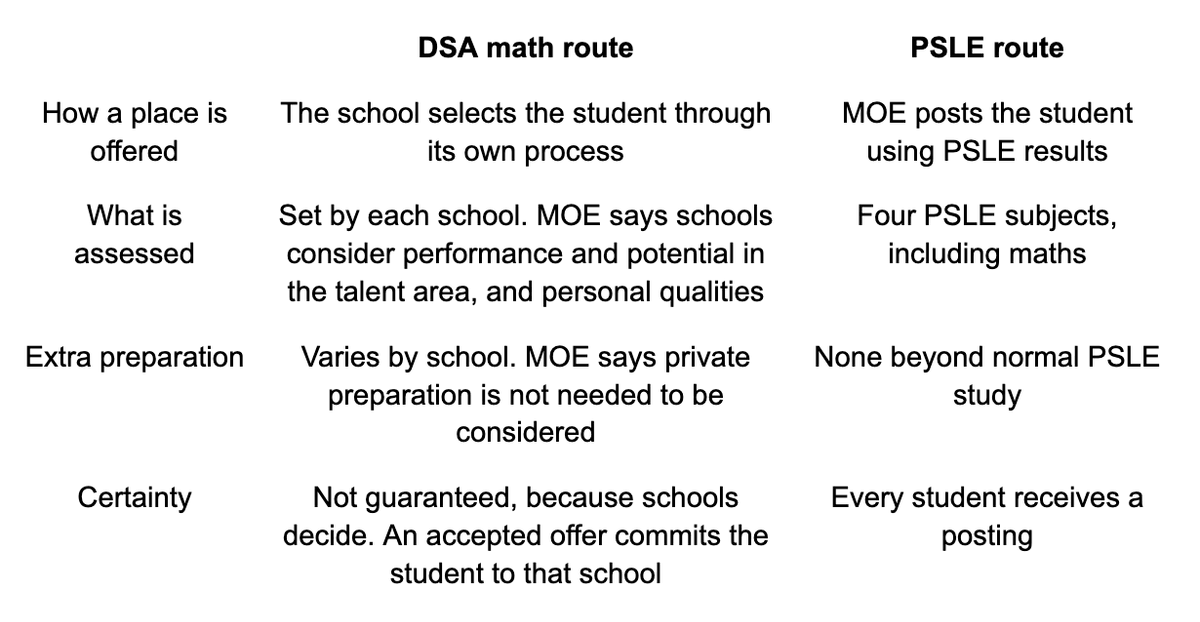
Under DSA, a secondary school chooses students through its own selection process. MOE says schools consider performance and potential in the talent area, as well as personal qualities. The PSLE route places students using their PSLE Achievement Level scores. A student can try DSA and still sit the PSLE, but a student who takes up a confirmed DSA offer does not take part in the Secondary 1 Posting Exercise.
The main difference in the maths itself is the style of question. PSLE questions follow the syllabus, even when they are hard. In our DSA classes, we train students in advanced, non-routine problems because they require more than just recalling a method. That is why a child with excellent school marks can still hesitate on the first unfamiliar problem.
Which Students Suit DSA Math
We suggest DSA Math for students who already solve multi-step problems independently, enjoy unfamiliar questions, and have a school in mind that suits them. A strong school grade alone is not enough.
Three practical signs can help. The child finishes schoolwork quickly and asks for harder questions. The child stays with a difficult problem for several minutes before asking for help. The child can explain why a method works, not only that it works.
No programme can promise a DSA offer. Schools make that decision, and the group of applicants changes every year. MOE also states there is no need for private preparatory programmes to be considered for DSA, so extra tuition is a choice, not a requirement.
Will DSA Preparation Take Time Away From PSLE Revision?
It can, if the two are planned separately. Both reward careful reading and multi-step reasoning, so some practice helps both. But a child has limited hours. A sensible approach is to protect PSLE revision first, then add DSA-style problems in short, regular sessions.
MOE guidance is clear that students who take part in DSA still sit the PSLE, so PSLE revision cannot pause. A confirmed DSA offer is also conditional: the PSLE result must meet the school's Posting Group requirement, and the Integrated Programme requires at least Posting Group 3.
DSA applications open in May of Primary 6. In 2026, the application window ran from 6 May to 2 June, and schools gave outcomes by 28 August. Dates change each year, so check MOE’s DSA-Sec website for your child’s year. That makes Primary 5 the last full school year before applications open.
How Can I Decide for My Child?
Decide by looking at three things: your target school’s own DSA criteria, how your child handles unfamiliar problems, and how many hours each week your family can protect. If your child enjoys the challenge and has the time, add DSA-style practice to PSLE revision. If not, focus on the PSLE.
Here are four steps you can take this month:
Read the DSA notice on each target school’s website.
- Ask your child’s maths teacher how your child handles questions they have not seen before.
- Give your child five non-routine problems at home and note how long they stay with each one.
- Check MOE’s DSA-Sec website for the current year’s dates and rules before you plan.
- DSA practice adds to a child’s workload, so keep sessions short and ask how your child feels about them. Selection brings its own pressure whichever route you take.
FAQ
Can my child apply to more than one school through DSA?
One application form allows up to three choices, with at most two at the same school. Each school runs its own selection process, so read every notice carefully because dates and requirements can differ.
Does a DSA offer mean my child skips the PSLE?
No. A child with an offer still sits the PSLE. The place is guaranteed only if the PSLE result meets that school's Posting Group requirement, so plan revision time accordingly.
Does my child need a competition record to apply?
Schools set their own criteria, so check each notice. A competition record can show strength, but it is one kind of evidence among several.
What happens if DSA does not work out?
Your child goes through normal Secondary 1 posting using PSLE results. The problem-solving practice can still help with harder PSLE questions.
Is the DSA scheme changing?
MOE has said it is reviewing the DSA scheme, but nothing here can say what, if anything, will change. Check MOE’s DSA-Sec website for the rules that apply to your child’s year.
Next Step
If you want to see how this works for your child, you can book a trial lesson with The Math Classroom. A trial lesson costs $47.50 for one hour or $95 for a full two-hour lesson. The Math Classroom’s DSA course is aimed at students who consistently score 95 or more in school exams, and its Primary 6 competition and DSA students are taught together in Terms 1 and 2.