Parents in Singapore often stress over PSLE scores as the only path to top secondary schools. DSA offers another route to talent in areas such as mathematics. This guide breaks down DSA math for a clear understanding.
What is DSA?
Direct School Admission (DSA), overseen by the Ministry of Education (MOE), allows Primary 6 students to secure secondary school places based on demonstrated aptitude. This occurs before PSLE results influence the S1 Posting Exercise. Schools target specific talent areas, including mathematics, to identify high-potential applicants.
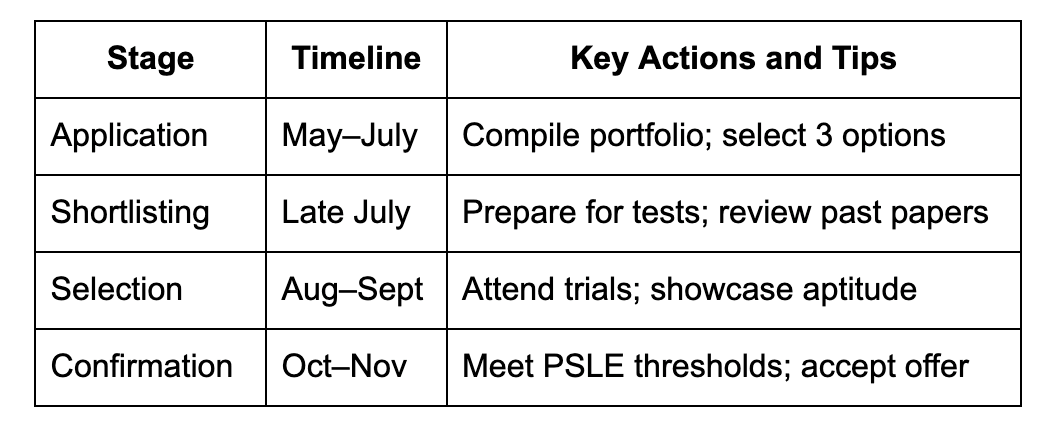
The application window spans May to early July via the MOE online portal. Students can apply to up to three schools or talent areas. Admission is provisional and depends on both selection results and meeting the school’s PSLE requirements.
DSA promotes holistic talent development beyond aggregate scores. It benefits students with uneven strengths, ensuring mathematics aptitude receives due recognition. Over 50% of secondary places in autonomous and specialised schools are filled through DSA.
DSA-Sec Specifics for Secondary Entry
DSA-Sec governs admissions to secondary schools, emphasising sustained talent. Primary 6 applicants submit evidence such as competition certificates and teacher testimonials. Schools conduct selection tests and interviews to assess whether students are suitable.
Once confirmed, DSA commitments bind students—no mid-stream switches post-PSLE. This stability aids transition planning. Assessments vary, with mathematics-focused tests evaluating problem-solving skills under time constraints.
Renowned institutions like Raffles Institution and NUS High School prioritise DSA-Sec. They seek applicants with consistent excellence, fostering environments for advanced learning. Early preparation aligns portfolios with school criteria.
Mathematics as a Core Talent Area
Mathematics qualifies under DSA's academic category, spotlighting analytical prowess. Schools value applicants who excel in non-routine problems, beyond standard syllabus mastery. Competition achievements serve as tangible proof of aptitude.
Qualifying feats include gold medals in the National Mathematics Olympiad of Schools (NMOS) or distinctions in the Regional Mathematics Olympiad (RMO). Students should build a portfolio showing their progress from Primary 4 onwards. This demonstrates sustained passion and growth.
DSA math spots remain competitive, often limited to 10-20 per school. During interviews, schools often ask students to explain their thinking and problem-solving approach. Strong fundamentals predict success in enriched secondary curricula.
The DSA Application Process
Applications launch in early May and close mid-July for most schools. Parents upload achievements and references through the online portal. Shortlisting notifications arrive by late July.
From August to September, shortlisted candidates attend selection centres. These features include mathematics exams, group activities, or viva voce. Offers issue in phases from October, finalised post-PSLE in late November.
Preparing for DSA Math
Commence enrichment in Primary 4 to build competition readiness. Programmes combine the MOE syllabus with Olympiad techniques, such as pattern recognition, logic, and problem-solving strategies. Track milestones: aim to be in the top 10% in SASMO by Primary 5.
PSLE mathematics demands AL1-AL2 to complement DSA. Diagnostic assessments pinpoint gaps in algebra or geometry. Weekly drills simulate exam pressure, honing speed and accuracy.
Parents monitor holistic development—leadership in math clubs adds value. Balance prevents burnout and sustains peak performance. Resources like past NMOS papers prove invaluable.
Competition Role in DSA
Math competitions form the backbone of DSA portfolios. Events like the Asia Pacific Mathematical Olympiad for Primary Schools (APMOPS) or the Singapore Astronomy and Mathematics Olympiad benchmark talent. Schools mandate minimum awards for consideration.
Primary 6 timing aligns with application deadlines—secure results by April. Training camps refine heuristics for novel challenges. Success signals readiness for secondary rigour.
PSLE and DSA Link
All DSA admissions are based on attaining PSLE scores within the school's designated posting group thresholds. Strong Achievement Levels (AL1-AL4) in mathematics particularly reinforce the validity of offers, providing a safety net. Pursuing excellence across both DSA and PSLE avenues maximises opportunities for optimal secondary school placement.
Failure to meet these PSLE minima results in the automatic nullification of DSA spots, a safeguard to maintain academic standards. Top DSA math candidates invariably target high benchmarks regardless, reflecting their commitment. This integrated dual-focus strategy reliably unlocks access to Singapore's premier secondary schools.
Our Enrichment Programmes
The Math Classroom specialises in delivering tailored PSLE, secondary school, and competition mathematics programmes crafted to instil profound conceptual mastery. Our programmes help students understand concepts deeply and apply them confidently to unfamiliar questions. Participants emerge not just prepared, but empowered for advanced challenges.
Small-group settings enable personalised instruction, allowing tutors to effectively address individual needs. We systematically rectify conceptual errors and elevate overall exam performance through proven methodologies. Introductory trial sessions are available for $45 per one-hour class.
Boost DSA Readiness
Our DSA-Sec programme directly addresses direct school admission requirements, honing the precise aptitude needed for mathematics talent areas. Enrichment modules simulate selection scenarios, fostering resilience and strategic thinking under timed conditions. Participants emerge fully equipped for interviews and tests.
Competition preparation encompasses NMOS, SASMO, and beyond, while secondary transition programmes bridge PSLE to new challenges. Enrolment strengthens applications holistically—reach out for personalised schedules. Our track record shows that 92% of students attain AL1-AL4 in PSLE mathematics, driven by our rigorous emphasis on problem-solving.