Students lose marks on problem sums because the question joins several topics and concepts, hides the first step in a story, and rewards written method as well as the final answer. PSLE Math Tuition helps when it trains students to identify the keyword and strategies, and put them into workings. Going through a topic the student already understands does not build those skills.
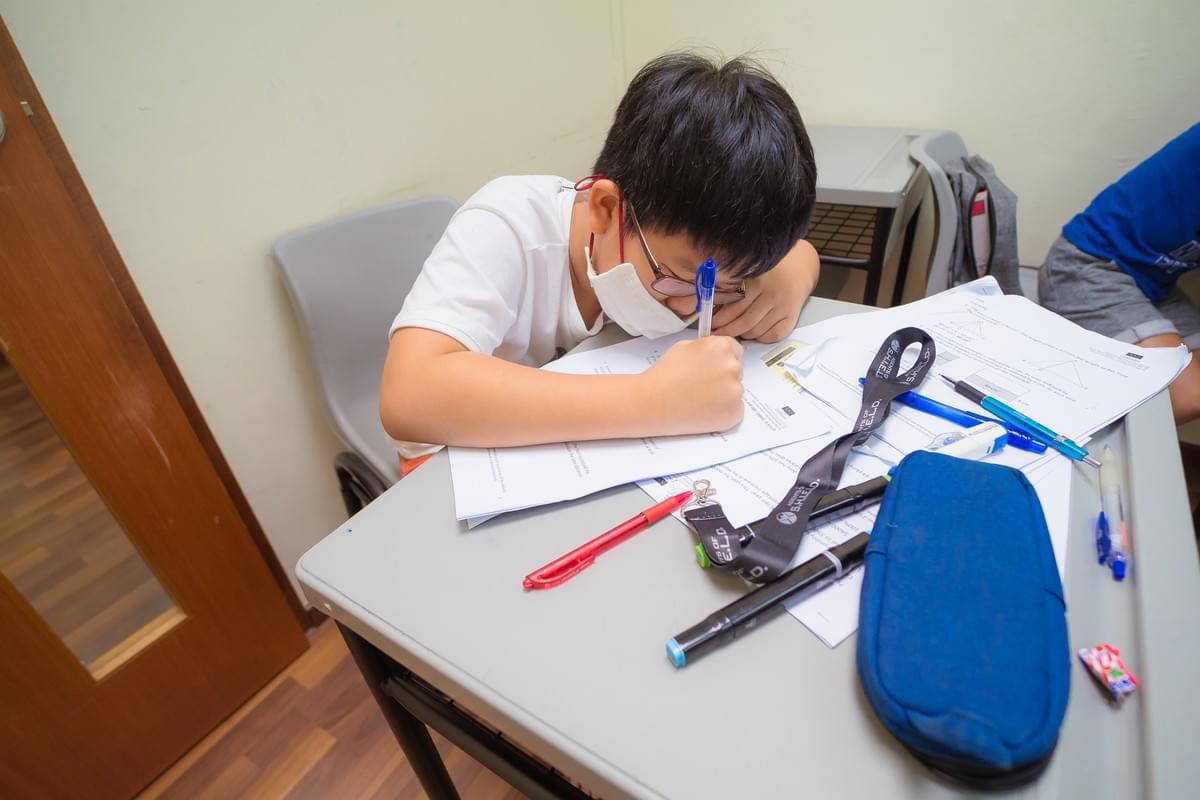
A topical lesson shows one idea in isolation. A problem sum joins several ideas and concepts and hides the first step in words, so a student must decide what to do before calculating anything.
The Singapore Examinations and Assessment Board (SEAB) sets two PSLE Mathematics papers. Paper 2 includes 10 structured or long-answer questions worth 3, 4 or 5 marks each, and SEAB’s syllabus says candidates must show their method of solution (working steps) clearly for these questions. Some two-mark short-answer questions also give one mark for a correct method when the final answer is wrong.
Where the Marks Go
Three common mistakes are misreading the question, choosing the wrong first step, and leaving out working. Each one is a habit, not a lack of intelligence, so each can be corrected with practice that targets the habit directly.
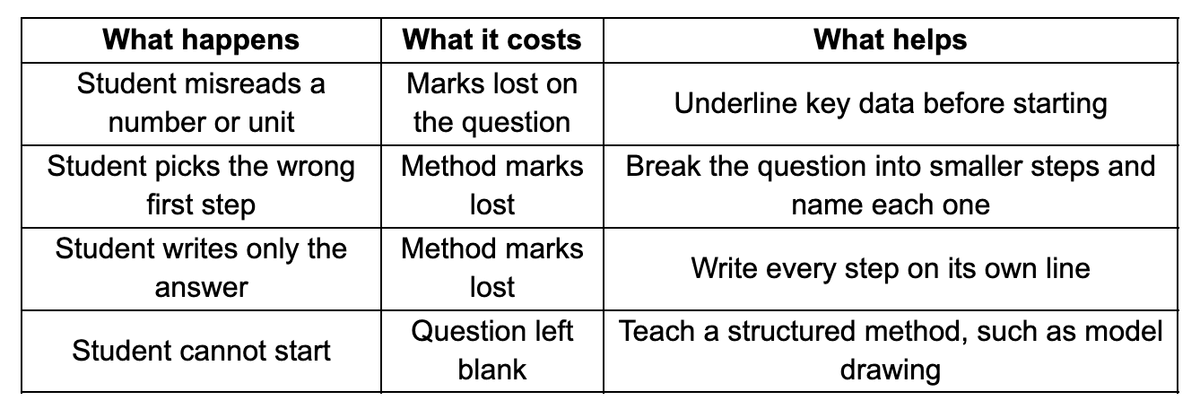
Model drawing and other heuristics are taught from Primary 3 in our programme, so students meet problem sums gradually, not in the final months.
What Good PSLE Math Tuition Does Differently
Good PSLE math tuition finds which habit is costing a student marks, then trains that habit directly. It does not simply repeat the syllabus. It tests the student on similar problems until the student solves them alone, and it corrects each misconception as soon as the teacher sees it.
This follows our teaching aims. We want students to understand everything we teach, to solve similar types of questions on their own, and to learn frameworks they can use on new questions. Our teachers have taught at top 8 schools in Singapore, studied mathematics at a high level at university, or have many years of teaching experience. Our post on when to start PSLE math tuition explains the timing.
It is not a quick fix. A student who practises only during the lesson hour changes more slowly than one who reviews at home. We cannot promise a grade.
What Can I Do at Home This Week?
Ask your child to explain the first step of three problem sums before solving them. If your child cannot name the first step, the weak area is choosing a method. If the first step is right but the answer is wrong, the weak area is careful working.
That one check tells you which habit to work on. It also gives a teacher a clear starting point.
FAQ
My child gets the answer right but loses marks. Why?
In multi-mark questions, the working carries marks. Ask your child to write each step on its own line, even when the step seems obvious.
How many problem sums should my child practise each week?
There is no fixed number. A few sums reviewed carefully, with each mistake explained, help more than many sums done quickly.
Should my child re-learn topics before doing problem sums?
Re-learn a topic only when your child cannot explain it. If your child can explain the topic but struggles with the word problem, the missing skill is problem solving strategies , not the topic itself.
Next Step
You can book a trial lesson with The Math Classroom to have the teacher assess your child’s strengths and areas for improvement and give a personalised learning recommendation. A trial lesson costs $47.50 for one hour or $95 for a full two-hour lesson.