

Primary School Math Tuition
A report card comes home and the math grade has slipped, or stayed flat despite weeks of extra worksheets at home. You are left wondering whether this needs a proper tutor, or whether your child just needs to try harder.
Usually, it is neither. It is a specific gap that has not been identified yet, and a general worksheet cannot find it. Our Primary School Math Tuition is built to identify that gap directly, then close it with structured, guided support for students from Primary 1 to Primary 6.
Why Do Some Children Fall Behind in School Maths?
It is rarely about effort. A child can spend an hour a night on worksheets and still not improve, because the worksheets repeat what they already know rather than targeting what they do not.
Two common patterns show up again and again. A student either has a gap in an earlier concept that never fully closed, so every topic built on top of it wobbles too. Or a student understands each topic or concept taught in isolation but cannot yet combine two or three of them in a single question, which is how many exam questions are built from Primary 4 onwards.
Here is the direct answer: falling behind in school maths is almost always about an unidentified specific gap, not a lack of effort. Tuition works by finding that gap and rebuilding it, rather than adding more general practice on top of it.
What Does Primary School Math Tuition Actually Involve?
Our programme is structured around two stages that reflect how the school syllabus and its demands change over time.
Lower Primary (P1 to P3) focuses on fundamental concepts, number operations, mental calculation, and building genuine confidence before harder material arrives.
Upper Primary (P4 to P6) shifts towards multi-step problem solving, higher-order thinking, exam strategy, and PSLE preparation, since this is where school exam questions start combining several topics at once.
Stage Levels What lessons focus on
Lower Primary P1 to P3 Fundamentals, Number Operations, Number Sense
Upper Primary P4 to P6 Multi-step questions, exam strategy, PSLE prep
For families whose focus is specifically the PSLE stage, our dedicated PSLE Math Tuition page covers that in more depth.
Is This Only for Students Who Are Struggling?
No. Primary School Math Tuition at The Math Classroom runs across three levels, since "struggling", "keeping up", and "wanting more" are three different problems that need three different responses.
Foundation Mathematics rebuilds fundamentals for students with real learning gaps or low confidence.
Core Primary Mathematics reinforces and sharpens what school already teaches, for students who are keeping pace but want steadier accuracy.
Advanced Mathematics pushes further into non-routine, higher-order questions, for students who find school maths too easy and are ready for more.
A student is placed according to where they actually are, not their age or year level alone, and can move between these levels as their results and confidence change.
What Happens If My Child Is Genuinely Behind, Not Just Struggling With One Topic?
This calls for a slower, more deliberate pace than most parents expect. The concept gets re-taught from a different angle, in smaller steps than the class average, with enough repetition to rebuild both the skill and the confidence that a run of poor results usually damages first.
Bethany Cheong, a Primary 6 student at Methodist Girls School, had been placed in a remedial class in Primary 5. She was "taken out of remedial class" within two terms and has "consistently scored High As" since.
What If My Child Is Actually Ahead of Their School Class
A student who finds school maths too easy is at risk of a different problem: boredom, then a slow drop in engagement that eventually shows up as careless mistakes on questions they could easily solve. Advanced Mathematics keeps these students genuinely stretched, and students who show strong ability here can progress into our dedicated Math Olympiad Training programme for a competition-focused setting.
What Should I Actually Expect From Tuition?
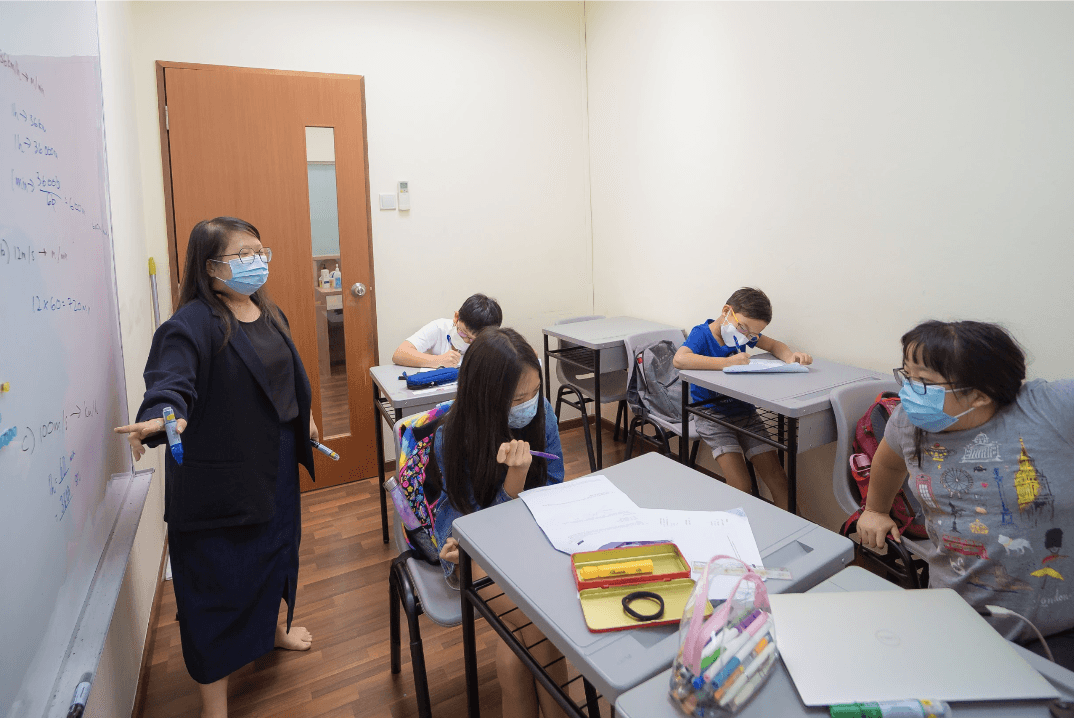
Concept-based learning that explains why a method works, not just what the answer is, so understanding holds up when a question is phrased differently from what a child has practised. Step-by-step problem solving that breaks a hard question into a process a child can repeat, rather than guesswork. Small class sizes that let a teacher notice and address a specific gap in real time, rather than teaching to the average of a large group.
Our teachers bring backgrounds that include teaching at top schools in Singapore and experience with Mathematics competitions. You can read more about our approach to teaching.
What Is the Honest Limit Here?
Tuition identifies and rebuilds a gap. It cannot do that work alone. A child who only engages with maths during the lesson hour, and nothing between lessons, will close a gap more slowly than one who reviews consistently at home. This applies whether the goal is catching up or staying ahead.
Frequently Asked Questions
My child's school grades have dropped suddenly. Is this a tuition problem or something else?
It could be either, so it is worth checking both. Ask the school first, since a sudden drop can reflect a change in class pace, a specific missed topic, or something unrelated to maths ability. Tuition helps most once you know roughly where the gap sits, though a trial lesson can also help identify it directly.Should I wait until year-end exams to see if tuition is needed?
Waiting means the gap has more time to compound, since later topics build on earlier ones. Starting once a pattern appears, rather than waiting for a full term of results, gives more time to close it properly.My child does fine in school tests but panics on harder assessment book questions. Does that matter?
Yes. This usually signals a gap between recognising familiar question types and handling unfamiliar ones, which is precisely what multi-step and non-routine practice is designed to address before it shows up in a real exam.Can my child move between Foundation, Core, and Advanced levels later on?
Yes. Placement reflects where a student is at a given point, not a fixed track. As results and confidence change, so does the level of work.Book a Trial Class
Whether your child needs a specific gap identified and rebuilt, steady reinforcement of what school already covers, or more of a challenge than the classroom currently offers, our Primary School Math Tuition programme starts with finding out exactly where they stand.
A trial lesson costs $47.50 for one hour or $95 for a full two-hour lesson.
Book a Trial Class or get in touch with our team to discuss your child's specific needs.
